Payrix Review
Pioneer PFaaS provider enabling ISVs to embed and monetize payments, now backed by Worldpay's global infrastructure.
Overview
Payrix was one of the first PayFac-as-a-Service platforms built specifically for ISVs. Acquired by Worldpay (FIS), it combines deep PFaaS expertise with the resources of the world's largest payment processor. ISVs use Payrix to embed payments, control merchant pricing, and earn transaction revenue.
For the latest on Payrix's ISV capabilities, documentation, and partner programs, visit payrix.com.
Pricing
Custom PFaaS
Custom PFaaS pricing with interchange-plus and ISV markup control. Backed by Worldpay acquiring. Volume-based tiers.
Full pricing breakdown →Pros
- ✓One of the original PFaaS providers — deep expertise
- ✓White-label embedded payments for ISVs
- ✓Now backed by Worldpay/FIS resources
- ✓Full merchant lifecycle management
Cons
- ✗Worldpay acquisition may reduce independence
- ✗Less brand recognition than Stripe or Finix in ISV community
- ✗Integration complexity higher than newer PFaaS providers
- ✗Pricing less transparent post-acquisition
ISV Fit
Best for ISVs wanting proven PFaaS technology with the backing of a global processor. Consider whether Worldpay ownership aligns with your independence and flexibility requirements.
Payrix Review: An ISV’s Perspective
This review evaluates Payrix specifically from the ISV and SaaS platform perspective. While many reviews focus on small business or e-commerce use cases, ISVs have fundamentally different requirements: embedded payment facilitation, sub-merchant onboarding, revenue sharing, and white-label capabilities.
What ISVs Should Know About Payrix
Payrix scores 3.8/5 in our ISV-focused evaluation. The rating reflects the platform’s capabilities for embedded payments, not general payment processing. A provider can be excellent for direct merchants but mediocre for ISV integration — and vice versa.
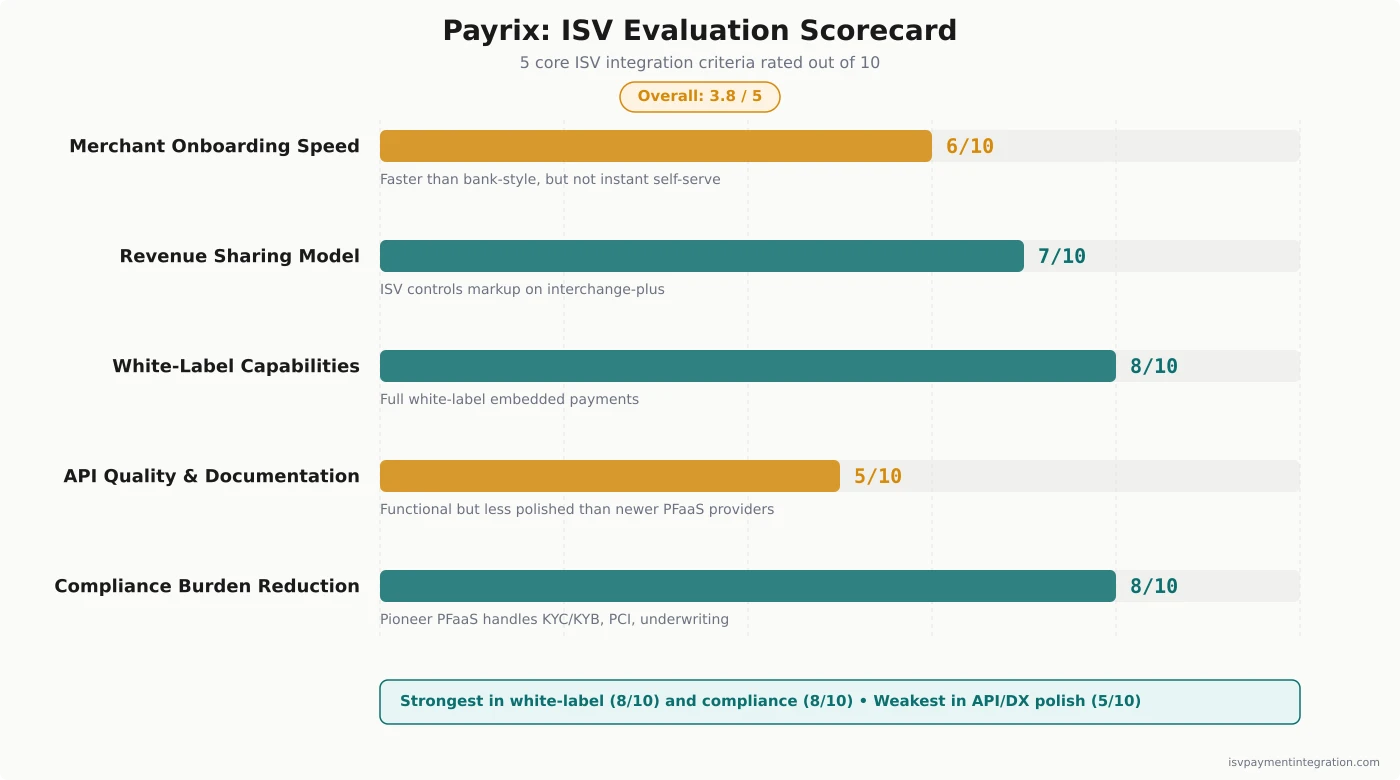
For ISVs, the key evaluation criteria are:
- Merchant onboarding speed: How quickly can your software’s users start accepting payments? Minutes vs. days matters for activation rates.
- Revenue sharing model: What percentage of each transaction does your ISV earn? This directly impacts your payment revenue line. See our Payrix pricing breakdown for specific revenue share ranges and interchange-plus economics.
- White-label capabilities: Does the payment experience carry your brand or the processor’s? This affects merchant perception and switching costs.
- API quality and documentation: ISV developers need clean APIs, comprehensive docs, and responsive sandbox environments. Payrix’s developer documentation covers API endpoints, webhook configuration, and sandbox testing.
- Compliance burden: How much of the PCI, KYC/KYB, and regulatory compliance does the platform handle vs. leaving to the ISV?
Payrix as a PFaaS Pioneer
Payrix was one of the first platforms to offer PayFac-as-a-Service (PFaaS) specifically for software companies. Before Payrix, ISVs that wanted to act as payment facilitators had to either register directly with card networks — a process requiring millions in reserves and years of compliance work — or settle for basic payment gateway integrations that offered no revenue share.
Payrix’s model lets ISVs embed full payment facilitation into their software without the regulatory overhead of becoming a registered PayFac. The ISV controls merchant pricing, keeps a share of transaction revenue, and presents the payment experience under its own brand.
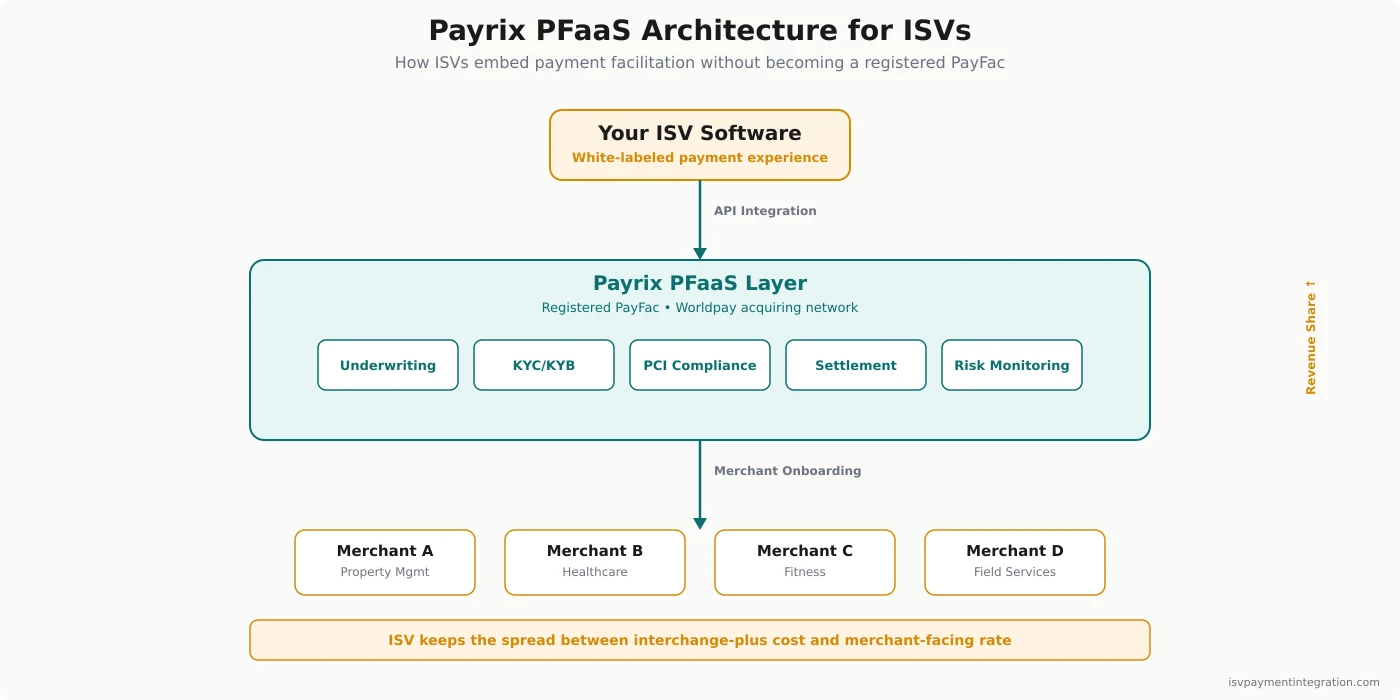
This pioneer status matters because Payrix has iterated on the PFaaS model longer than most competitors. The platform handles merchant underwriting, KYC/KYB verification, PCI compliance, and risk monitoring — all the components that make becoming a PayFac prohibitively complex for most software companies. According to McKinsey’s ISV payments research, ISV payment processing revenue in the U.S. has grown 20% annually, validating the model Payrix helped create.
The Worldpay Acquisition: What It Means for ISVs
FIS — the parent of Worldpay at the time — announced the acquisition of Payrix on February 15, 2022, bringing the PFaaS platform under one of the world’s largest payment processors. By September 2022, FIS had rebranded the platform-facing offering as Worldpay for Platforms, folding Payrix into a unified ISV stack alongside Worldpay’s broader acquiring network. In January 2026, Global Payments closed its $24.25B acquisition of Worldpay, so Payrix now sits inside that combined entity. For ISVs currently using Payrix or evaluating it, this corporate arc creates both opportunities and risks.
Opportunities: Worldpay processes over $2 trillion annually. ISVs on Payrix gain access to Worldpay’s global acquiring network, broader card brand relationships, and enterprise-grade infrastructure. For ISVs scaling internationally, Worldpay’s existing presence in 146+ countries could simplify cross-border expansion.
Risks: Large acquirers have a history of absorbing smaller, ISV-friendly platforms and gradually deprioritizing them. ISVs should watch for changes to pricing transparency, contract terms, and the independence of Payrix’s product roadmap. The Worldpay vs Payrix comparison examines how the parent company’s own ISV offerings overlap with Payrix’s positioning.
Integration Depth and Developer Experience
Payrix offers a REST API with endpoints covering merchant onboarding, transaction processing, reporting, and fund disbursement. The payment API integration supports both hosted and fully embedded checkout experiences, giving ISVs flexibility in how deeply they integrate payments.
Where Payrix shows its age is in developer experience. Compared to newer PFaaS providers like Finix or Tilled, Payrix’s documentation can feel less polished and its sandbox environment less intuitive. ISV engineering teams accustomed to Stripe-quality developer tools may find the onboarding curve steeper.
That said, Payrix compensates with dedicated ISV solution engineering support. Rather than self-serve documentation alone, Payrix assigns integration specialists to ISV partners — a relationship-driven approach that works well for mid-market ISVs but may frustrate smaller platforms that prefer self-service.
Revenue Share and Monetization Model
The core value proposition for ISVs considering embedded payments is revenue share. Payrix operates on an interchange-plus model where the ISV controls the markup charged to its merchants. The ISV keeps the spread between the interchange-plus cost and the merchant-facing rate.
This model gives ISVs significant pricing flexibility but requires understanding of interchange economics. ISVs processing high volumes in low-risk verticals (like B2B SaaS billing) will see better margins than those in high-risk categories. For a detailed breakdown, see our Payrix pricing analysis.
Vertical Market Fit
Payrix has historically focused on several vertical markets where integrated payments for SaaS create the most value:
- Property management — rent collection, maintenance payments, HOA dues
- Healthcare — patient payments, insurance copays, billing integration
- Fitness and wellness — membership billing, class bookings, retail POS
- Field services — invoicing, mobile payments, recurring billing
- Nonprofit — donation processing, event ticketing, membership dues
ISVs in these verticals will find Payrix has pre-built compliance frameworks, underwriting rules, and risk models tuned to their industry. ISVs outside these core verticals can still use Payrix, but may find less specialized support.
Who Should Consider Payrix
Payrix fits certain ISV profiles better than others. The platform’s strengths align with specific vertical markets, transaction volumes, and integration depth requirements. ISVs should evaluate Payrix alongside 2-3 alternatives using a structured scorecard that weights ISV-specific capabilities higher than general payment features. Compare directly: Stripe vs Payrix, Finix vs Payrix, or Adyen vs Payrix.
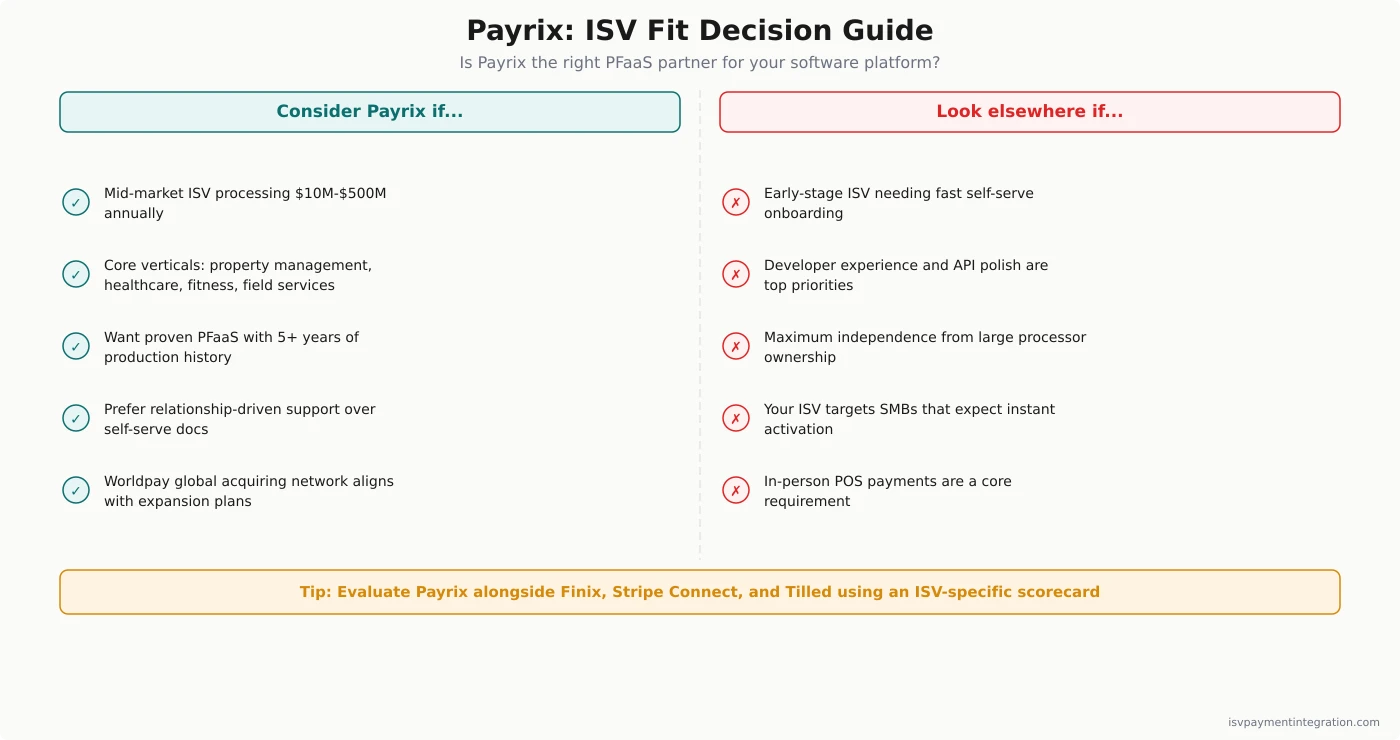
Strong fit:
- Mid-market ISVs processing $10M–$500M annually that want proven PFaaS infrastructure
- ISVs in Payrix’s core verticals (property management, healthcare, fitness, field services)
- Platforms that prefer relationship-driven support over pure self-service
- ISVs comfortable with the Worldpay acquisition and its long-term implications
Weaker fit:
- Early-stage ISVs wanting fast self-serve onboarding — consider Stripe or Tilled
- ISVs prioritizing maximum independence from large processors — consider Finix or Stax
- Platforms needing cutting-edge developer tooling — Stripe still leads here
- ISVs requiring payment terminal hardware for in-person payments — evaluate Payrix’s POS capabilities carefully against Square
The Bottom Line
No payment platform is perfect for every ISV. Payrix has clear strengths and weaknesses that make it ideal for some integration patterns and less suitable for others. The right choice depends on your specific vertical, merchant profile, transaction volumes, and how much control you want over the payment experience. For a detailed cost analysis, see our Payrix pricing breakdown covering interchange-plus economics and ISV revenue share models.