Payrix vs Tilled
A feature-by-feature comparison for ISVs integrating payments.
Payrix and Tilled both offer PayFac-as-a-Service for software companies, but the choice now depends on corporate backing, revenue share transparency, and integration speed. Payrix sits inside Worldpay and is moving into Global Payments; Tilled remains independent with published 70–80% revenue share tiers and ~9-day average integration.
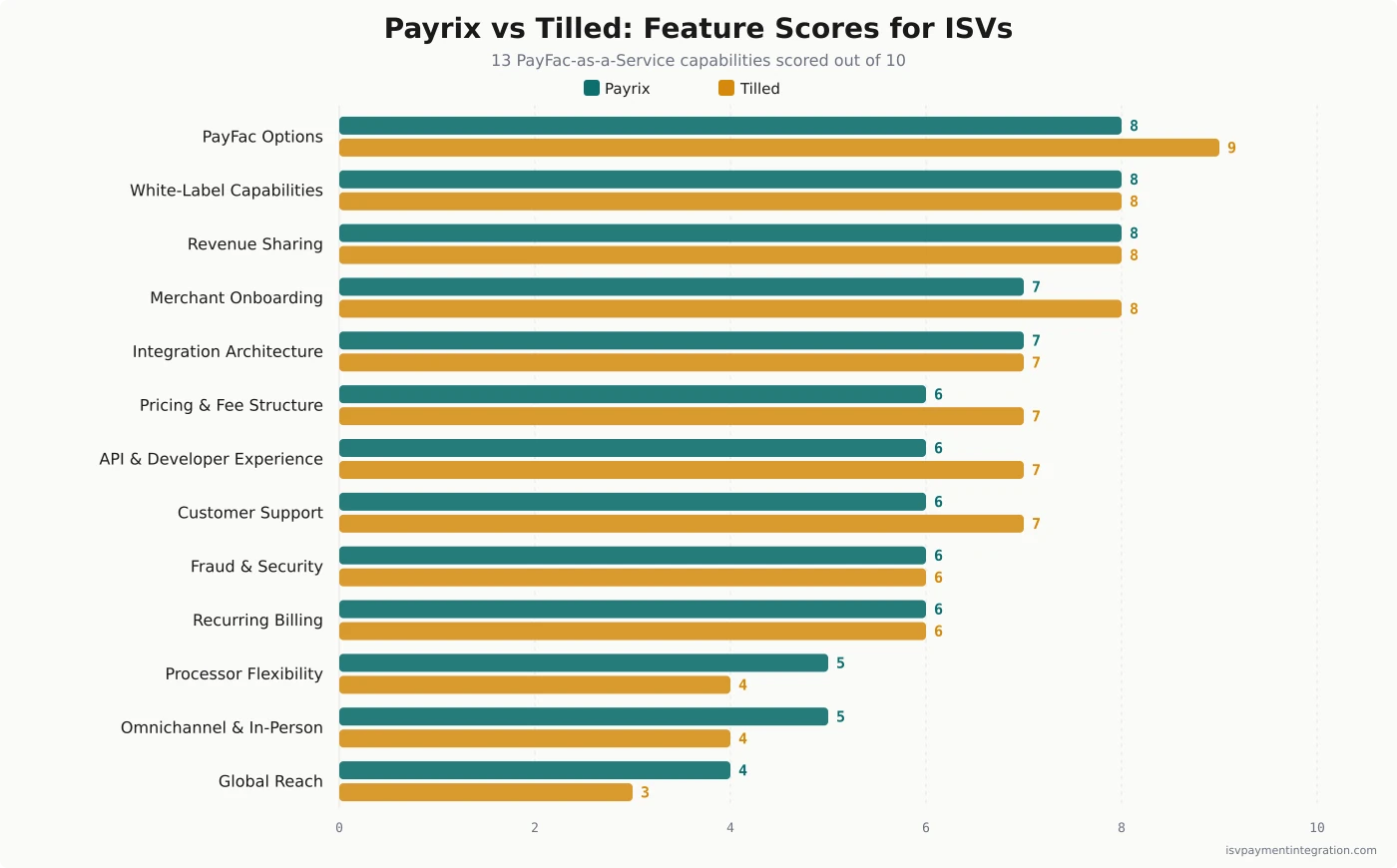
Feature Comparison
| Feature | Payrix | Tilled |
|---|---|---|
| Integration Architecture | 7 | 7 |
| API & Developer Experience | 6 | 7 |
| White-Label Capabilities | 8 | 8 |
| Processor Flexibility | 5 | 4 |
| Pricing & Fee Structure | 6 | 7 |
| Omnichannel & In-Person Payments | 5 | 4 |
| Fraud & Security | 6 | 6 |
| Revenue Sharing | 8 | 8 |
| Merchant Onboarding | 7 | 8 |
| Global Reach | 4 | 3 |
| Recurring Billing | 6 | 6 |
| Customer Support | 6 | 7 |
| PayFac Options | 8 | 9 |
Get this comparison as a shareable PDF
We'll send the Payrix vs Tilled breakdown to your inbox — ready to share with your team.
Best for
Payrix
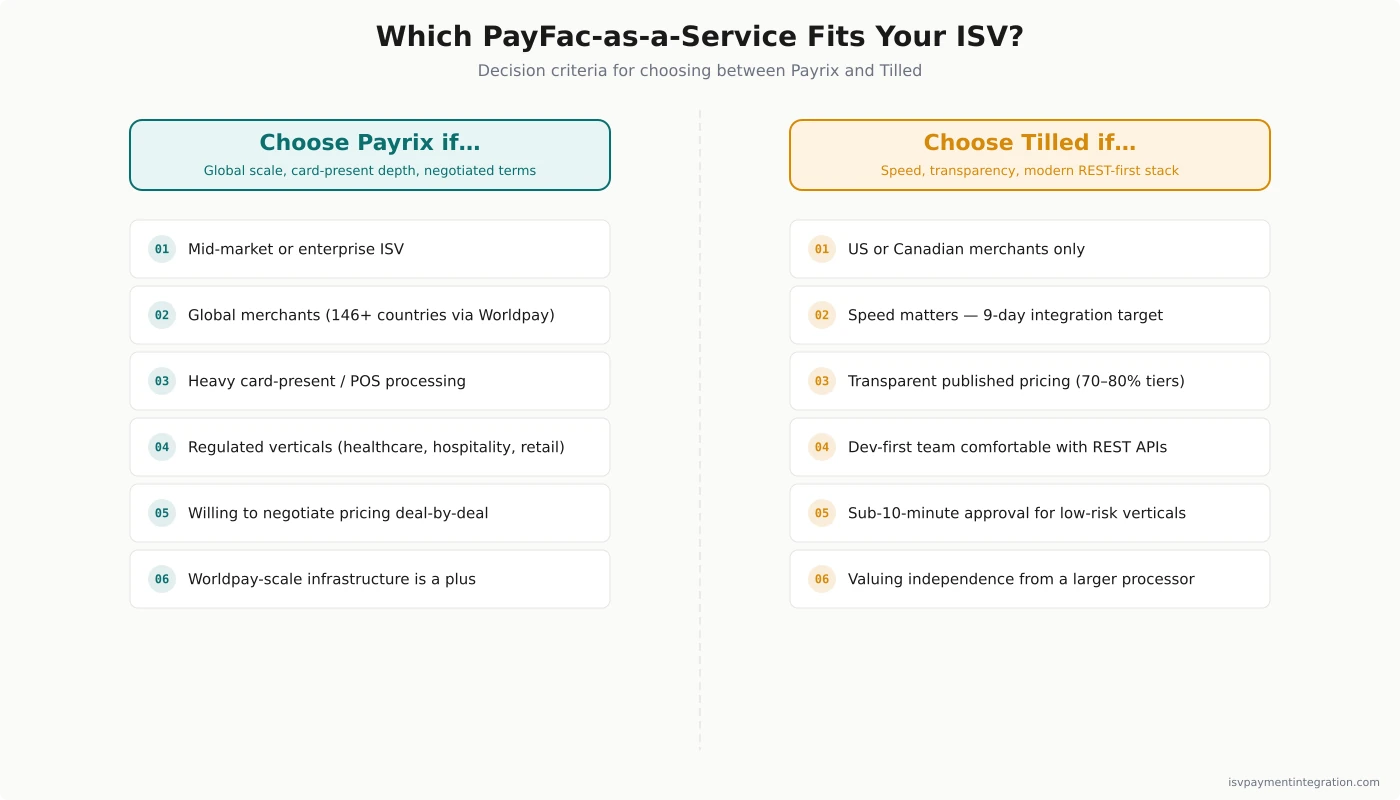
ISVs wanting enterprise-grade PFaaS with Worldpay's global acquiring, deep card-present capabilities, and vertical-specific support. Best for mid-market software companies in retail, hospitality, healthcare, or regulated industries processing significant volume.
Best for
Tilled
ISVs wanting a pure-play PayFac-as-a-Service with published revenue share tiers (70% under $5M/mo, 80% above) and ~9-day integration. Best for US and Canadian software companies that prioritize speed, transparency, and independence from a larger processor.
Payrix and Tilled are both payfac-as-a-service solutions built to help software companies switch on embedded payments without registering as a payment facilitator. Both run the payment facilitation process the ISV could never build alone — acquiring, underwriting, risk, gateway, and settlement services. Payrix is the older — a pioneer payfac in a box business, now owned by Worldpay and heading into Global Payments. Tilled is a pure-play, venture-backed payfac in a box focused on software companies in the US and Canada.
For an ISV, this choice shapes three things: how much of each transaction your business keeps, how fast the processing integration ships, and whether your embedded payments partner stays independent in two years.
The corporate story behind each platform
Payrix’s journey into Worldpay and Global Payments
Payrix was one of the first payfac solutions packaged for software platforms to license rather than build. FIS (Worldpay’s parent) announced the acquisition of Payrix in February 2022 and folded the product into Worldpay for Platforms. In 2025, Global Payments announced agreements to acquire Worldpay, moving Payrix solutions inside a larger global processing business.
Worldpay processes payments in 146+ countries, and card brands treat it as Tier 1 infrastructure. The risk is the usual one with an acquired payment facilitator — roadmap independence and pricing transparency can shift when a payfac business becomes a unit inside a larger payments company. See our Worldpay vs Payrix breakdown for how the parent positions against its own subsidiary.
Tilled’s independent path
Tilled has stayed independent. In October 2024 the business raised $12.5M led by Canvas Ventures and UPC Capital Ventures, extending card-present services and the international roadmap. That same month Tilled announced a partnership with North for added PFaaS processing capacity, and in July 2025 it signed a cross-border deal with KORT Payments covering Canada.
Positioning has not drifted. The payment facilitation solutions business still calls itself payfac as a service, and its customers are almost entirely software companies embedding payments. That focus shows up in the product: short integration windows, transparent pricing, and contracts written around the reality that ISVs sometimes need to move merchants off a platform.
Integration process and developer experience
Becoming a fully registered payfac yourself is a multi-year process. Historically it has taken six months or more of work with card brands and an acquiring bank, plus several hundred thousand dollars in upfront costs for technology, KYC, and a sponsor bank agreement. Both services remove that work — the platform is the registered payfac, and your software plugs in as the layer on top.
Tilled publishes an average partner integration of around nine days. Software companies get a sandbox, a modern REST API, webhooks, split payments, flexible payouts, and docs written for engineers who have used Stripe before. Merchant approval through Tilled’s underwriting can land in under 10 minutes for low-risk verticals, shortening the time between signup and the first transaction.
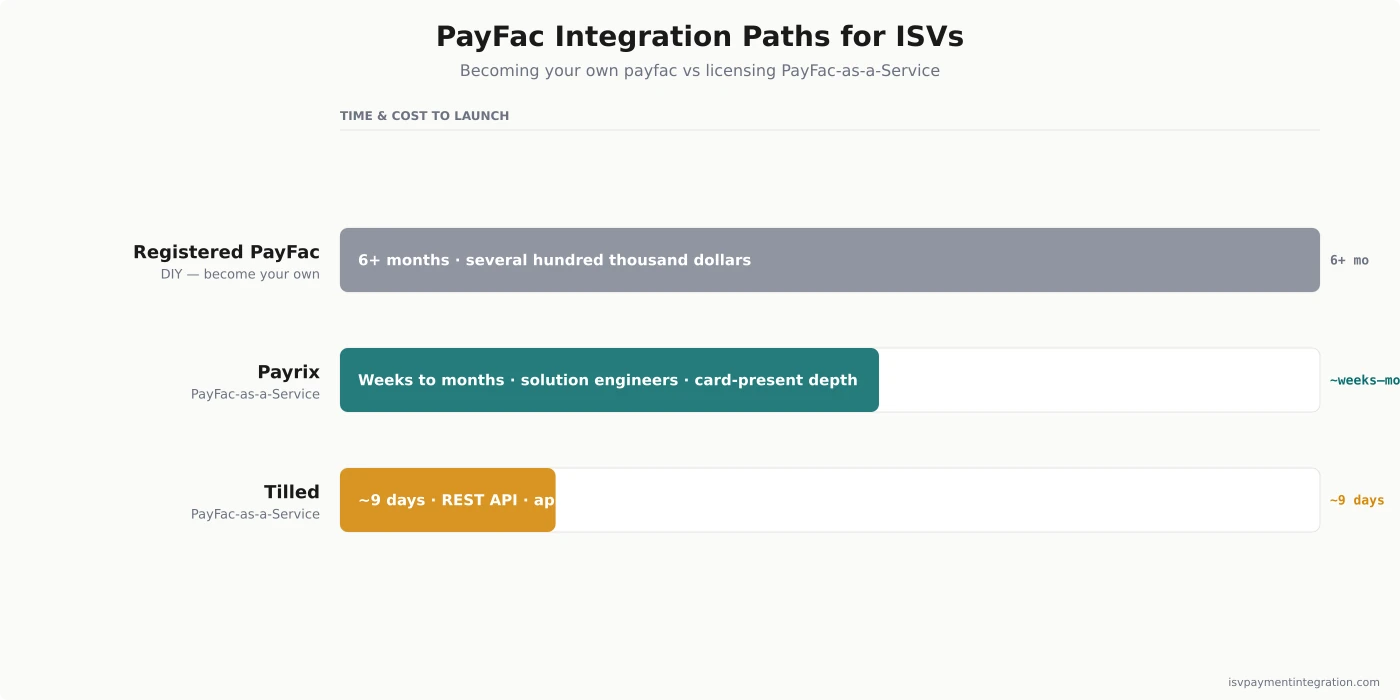
Payrix works differently. Solution engineers are assigned to ISV partners and run the implementation process relationship-first. That suits mid-market software companies with complex processing needs — card-present payment processing, POS, deep vertical integrations — but the API solutions are older than Tilled’s. Expect longer timelines and more back-and-forth with the Payrix team.
Both payfac solutions handle the heavy compliance work. Fraud monitoring, pci compliance, sub merchants onboarding, merchant id issuance, and risk management all sit on the payfac side. What changes is how much of the payment gateway surface, the tokenization gateway, and reporting services your engineers touch.
Pricing, revenue share, and economics
Both solutions price on interchange plus. Your ISV pays interchange plus a processing margin, and you set the merchant-facing rate. The spread is your payment revenue. What differs is how much of it each platform lets you keep, and how openly the numbers are disclosed.
Tilled publishes its tiers. The Start-Up plan gives a 70% revenue share on the markup above Tilled’s costs for ISVs processing under $5M per month, with a $500 monthly SaaS fee. The Scaling plan moves to an 80% revenue share for ISVs processing above $5M per month, with a $2,500 monthly SaaS fee (per Tilled’s pricing page). Enterprise terms are negotiated directly. The structure lets software companies model revenue against platform fees and pick a tier that matches current volume.
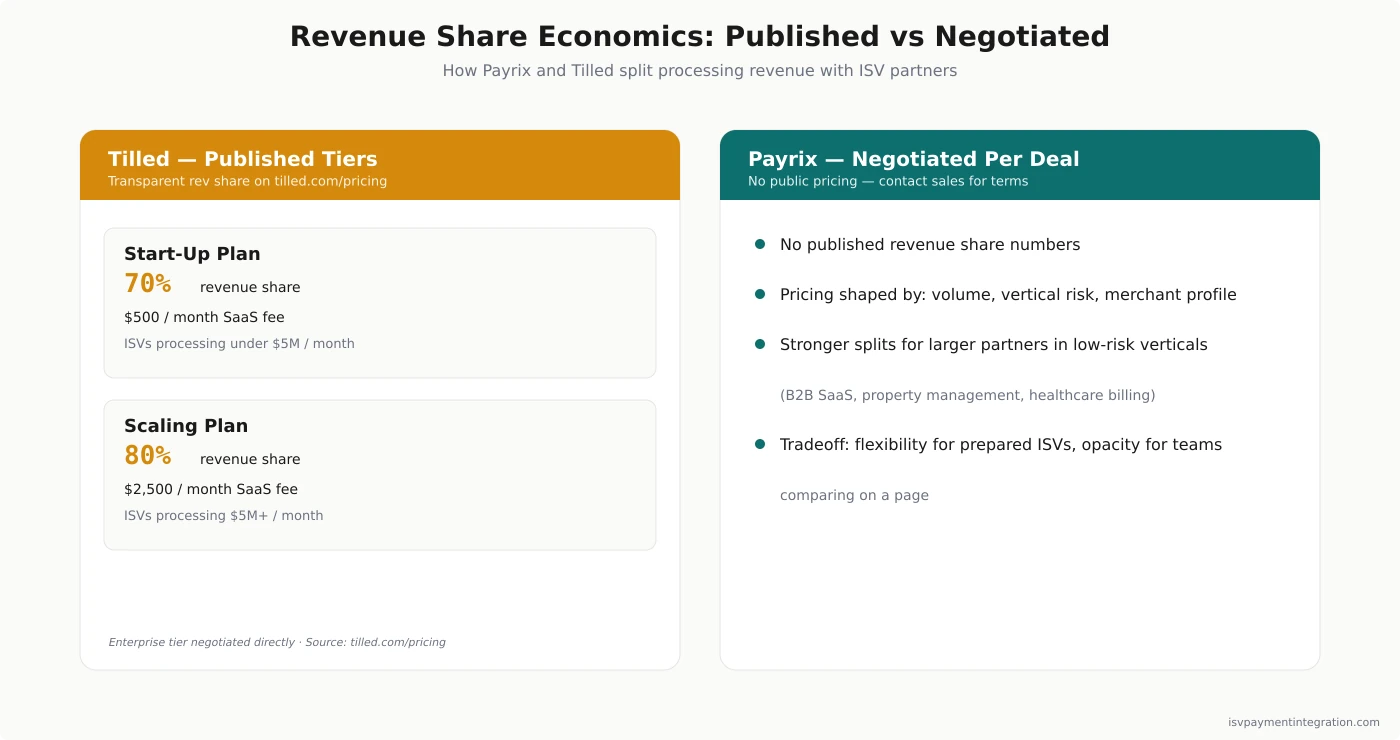
Payrix does not publish numbers. Pricing is negotiated per deal — volume, vertical risk, and merchant profile shape the figure. Larger payfac partners in low-risk verticals (B2B SaaS, property management, healthcare billing) negotiate stronger splits. The tradeoff: flexibility for prepared ISVs, opacity for teams comparing pricing on a page. Our Payrix pricing breakdown and Tilled pricing breakdown walk through both.
Which ISVs should pick which
The independent platform fits software companies that want speed, a dev-first process, published pricing, and US or Canadian merchant coverage. Businesses planning to scale quickly and valuing transparent payment facilitation economics tend to land here. If your engineers read Stripe’s docs for fun, the Tilled services feel familiar. The tradeoff is geography — it does not yet match Payrix’s international or card-present footprint.
Payrix fits software companies with global ambitions, heavy POS or card-present processing needs, or enterprise embedded payments solutions requirements that benefit from Worldpay-scale infrastructure. Businesses in retail, hospitality, or regulated industries often find Payrix a better fit than newer services or Braintree. The tradeoff is the corporate change curve — Worldpay, and soon Global Payments, will shape roadmap and pricing.
One fair question: what happens if the independent business gets acquired next? It is a legitimate concern in a consolidating market. Ask any payfac partner about portability — non-exclusivity, termination terms, and merchant migration rights — and get the answer in writing before signing. Those clauses decide whether you can move merchants to another payment facilitator if ownership or pricing changes.
For a second opinion on which fit makes sense for your volume, merchant mix, and implementation process, talk to a payments specialist. It is also worth comparing both against adjacent embedded payments solutions like Finix vs Tilled and Stripe vs Payrix before narrowing the shortlist.
Frequently Asked Questions
Is Payrix the same thing as Worldpay for Platforms now?
Payrix is the technology behind Worldpay for Platforms. After FIS acquired the business in 2022, the product became Worldpay’s ISV-facing embedded payments stack. In 2025, Global Payments announced its agreement to acquire Worldpay, which moves Payrix solutions into Global Payments’ software and platform partner portfolio. Existing integrations continue to run, but software companies should expect branding, pricing, and roadmap decisions to come from the parent rather than Payrix as a standalone services line.
Does Tilled work for ISVs outside the US?
The core acquiring is US-based. Through the 2025 KORT Payments partnership, the platform supports ISVs with merchants in Canada. Other international markets are not yet covered natively. Software companies that need payment processing in Europe, Latin America, or APAC will find Payrix’s Worldpay infrastructure a stronger fit today, though Tilled has signaled international expansion as part of its 2024 funding round.
What happens to my merchants if I switch from one platform to the other?
Switching payfac solutions requires re-boarding every sub-merchant on the new platform. Both services own the acquiring relationship and underwriting — those cannot be transferred. Expect a migration process that includes new merchant applications, tokenization transfer for saved cards, and a cutover window during which both platforms run in parallel. Contract terms — length, exclusivity, and termination fees — vary by partner and should be reviewed in writing with either platform before signing.
Do I need to become a registered PayFac to use either platform?
No. The point of payfac as a service is that the payfac itself handles the registration on your behalf. Payrix and Tilled take care of card brands registration, the sponsor bank relationship, fraud monitoring, and the KYC work that would otherwise take six months and significant upfront costs. Your ISV operates as a sub-payfac underneath — controlling pricing, owning the merchant experience, and earning payment facilitation revenue without the compliance liability of a fully registered payfac.